Vom SNF gefördertes Forschungsprojekt
Materialisierte Text-Körper & reparative Kritik
english below |
Forschungsprojekt von Ines Kleesattel & Elke Bippus, mit Pascale Schreibmüller & Ludgi Porto
01.10.2025 – 30.09.2028
Forschungsinstitution: Zürcher Hochschule der Künste – ZHdK
Institut: FSP Kulturnalyse in den Künsten Departement Kulturanalyse und Vermittlung ZHdK
Wissenschafliches Abstract
Das Projekt verschränkt kritische Theorie und relationale künstlerische Forschung, um Verfahren, Formen und Vermittlungsweisen einer reparativen Kritik zu untersuchen. Der Begriff des „Reparativen“ meint im queer-feministischen und post-kolonialen Kontext keine vollständig gelingende Heilung. Er verweist vielmehr auf Transformationspotenziale, die bestehende Verletzungen und Brüche im Affektiven entfalten können (vgl. Sedgwick). Unser Anliegen ist es, reparative Kritik als eine differenzorientierte relationale Praxis zu aktivieren, die der distanznehmenden „Hermeneutik des Verdachts“ (Ricoeur) thematisch und performativ-verkörpernd entgegenwirkt.Die Case Studies zweier künstlerisch forschender PhD-Kandidatinnen widmen sich situierten Potenzialen eines kreativ wie kritisch Reparativen. In queer-feministischen bzw. post-kolonialen Kontexten situiert, arbeiten sie an ästhetischen Praktiken verstrickter Subjektivierung und differenzieller Relationalität:• Die Sound Artist und praktizierende Hebamme Pascale Schreibmüller bearbeitet heterogenes Material zu pränatalem Kindsverlust. Gemeinsam mit Personen, die verkörperte Erfahrungswissen und/oder professionelle Bezüge zu solcher „Nicht-/Mutterschaft“ haben, erkundet sie mit spekulativem Storytelling, Sound- und Listening-Praktiken reparative Formen queerer Subjektivierung von (m)others. • Mit mehrsprachigem Schreiben, objektbezogener Vokalisierung und Besessenheitschoreografien untersucht Ludgi Porto rituelle Ästhetiken als reparative Praktiken im Kontext post-kolonialer Begegnung. In Bezug auf Lygia Clarks künstlerisch-therapeutische Arbeit mit relational objects und deren Beziehung zu afrobrasilianischen Ritualen widmet sie sich einer „Dekolonisierung des Unbewussten“ (Rolnik).Die in den prozessorientierten Case Studies entstehenden Materialen – Sound-Recordings, Relational Bodies Choreografien, Objekt-Assemblagen, Recherchefragmente, Props und Propositions – erlauben komplexe „semiotisch-materielle“ Wissensgefüge zu formen (Haraway, Barad). In Anlehnung an einen feministisch performativen Begriff von Text, wie ihn etwa die écriture féminine (Cixous) vorgestellt hat, nennen wir diese Gefüge Text-Körper. Text-Körper lassen sich in Traditionen der Conceptual Art, Institutions- und Repräsentationskritik stellen – und sind mit ihren performativen, affizierenden und emergenten Dimensionen auch als Praktiken relationaler Ästhetik zu fassen.Die Gesuchstellerinnen (Bippus, Kleesattel) tragen die Diskussion um Möglichkeiten und Herausforderungen von reparativer Kritik in kunstwissenschaftliche bzw. philosophisch-ästhetische Diskurse hinein. Sie leisten damit auch einen Beitrag zu Debatten um Methodologie und Relevanz hybrider künstlerisch-wissenschaftlicher Forschung. Zudem entwickeln sie material- und handlungsorientierte Impulse für Theoriearbeit im Sinne eines Doing Theory.Projektbegleitend entwickelt das Forschungsteam mit Expertinnen aus angewandter Theaterwissenschaft und Szenografie (Stefanie Lorey, Swoosh Lieu) ein choreo-szenografisches Vermittlungsformat, das darauf abzielt, die kritisch-reparativen Potenziale der Text-Körper in einer überfachlichen Öffentlichkeit mit-teilbar und transversal verhandelbar zu machen. Die projektleitenden Forschungsfragen lauten: • Mit welchen Verfahren kann künstlerisches Forschen Text-Körper materialisieren, die sowohl kritisch-differenzierend als auch relational-reparativ agieren? • Welche Möglichkeiten eröffnen Text-Körper, rationalistische Distanzierung und Subjekt-Objekt-Hierarchien nicht nur thematisch zu problematisieren, sondern auch ästhetisch-performativ in Bewegung zu bringen?• Welche Settings erlauben es, Text-Körper choreo-szenografisch so zu aktivieren, dass die Vermittlung ihrer kritisch-reparativen Potenziale nicht als autoritäre Belehrung, sondern intra-aktiv als gemeinsam-geteilte Wissenspraxis agiert?
Zusammenfassung
Zwei künstlerischen Case Studies bilden körperlich-materielle Wissensformen reparativer Kritik:
Pascale Schreibmüller befasst sich als Künstlerin und Hebamme mit Erfahrungen von Schwangerschaftsverlust. Mit experimentellen Praktiken des Hörens, Erzählens und Spekulierens untersucht sie Formen des damit verbundenen Trauerns, Erinnerns und In-Beziehung-Seins.
Ludgi Porto arbeitet mit performativen und skulpturalen Mitteln an Praktiken, die sich zwischen künstlerischen und therapeutischen Prozessen bewegen. In Auseinandersetzung mit der Künstlerin Lygia Clark sowie mit afrobrasilianischen Ritualen untersucht sie post-koloniale Ambivalenzen und reparative Potenziale.
Beide Case Studies verschränken verkörperte Erfahrungswissen mit kritisch-theoretischer Informiertheit. Entstehende Material-Assemblagen, partizipative Workshops, Installationen und Performances fassen wir als «Text-Körper», die quer zu strikten Trennungen von kritischer Theoriearbeit und künstlerischer Praxis liegen. Elke Bippus und Ines Kleesattel diskutieren die reparativ-kritischen Potenziale dieser Text-Körper im Kontext aktueller kulturwissenschaftlicher Diskurse, mit dem Anliegen, handlungsorientierte Impulse dafür zu formulieren, wie geisteswissenschaftliche Theorie mehr als kritische Praxis sensiblen Mit-Teilens und weniger dozierend agieren kann.
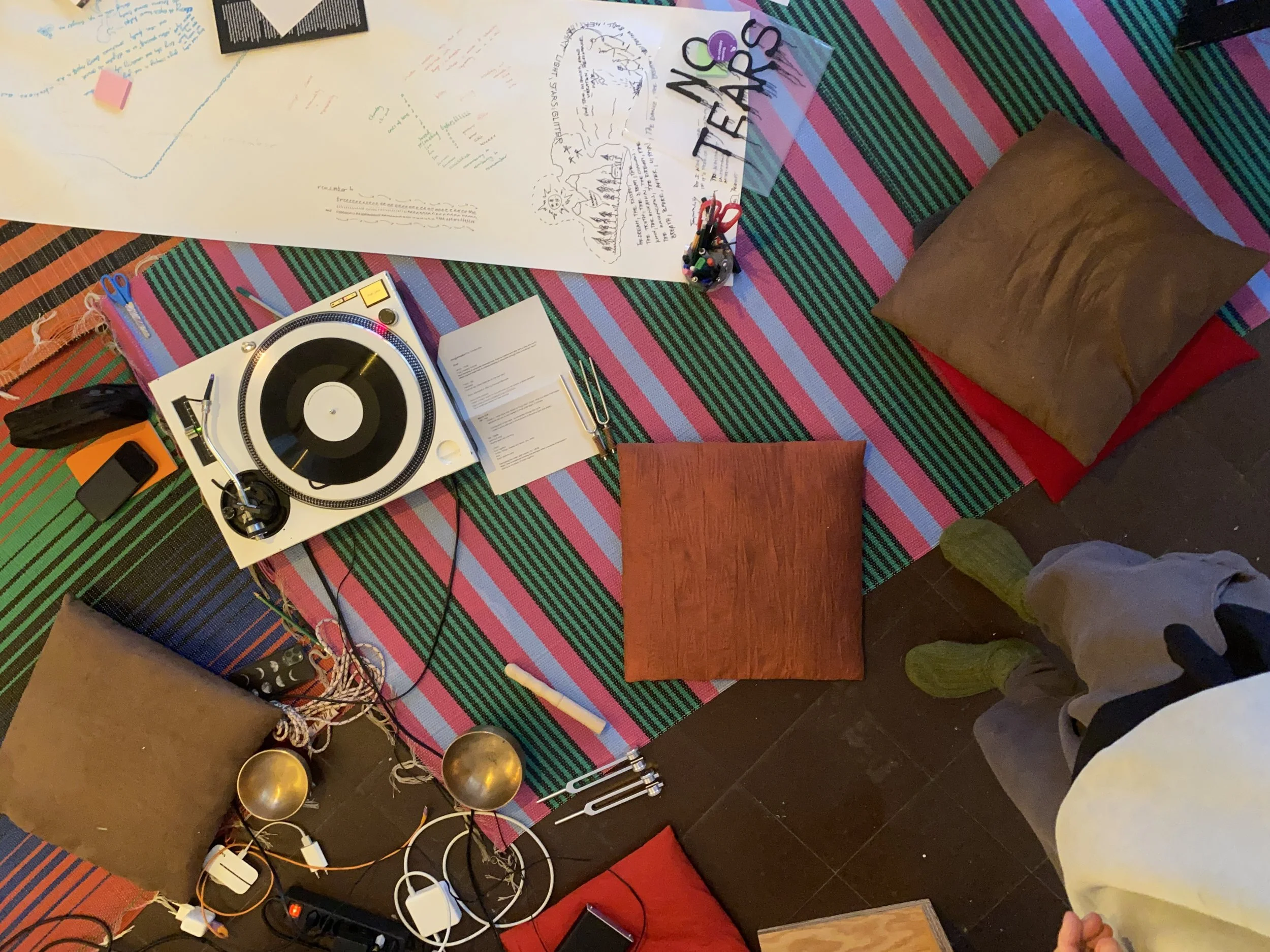
Quellen Titelbild | Sources Cover Image
Fragment aus dem Verfahrensworkshop #1 | Mit Les Complices (ZH) | 17.&18. März 2026
Excerpt from Process Workshop #1 | With Les Complices (ZH) | March 17 & 18, 2026
Bild | Pascale Schreibmüller
Research project funded by the SNF
Materialized Text-Bodies & Reparative Criticism
English below |
Research Project by Ines Kleesatte & Elke Bippus, with Ludgi Porto & Pascale Schreibmüller
October 1, 2025 - September 30, 2028
Research Institutin: Zurich University of the Arts – ZHdK
Institute: FSP Cultural Analysis in the Arts Department of Cultural Analysis and Mediation ZHdK
Academic Abstract
The project intertwines critical theory and relational artistic research to examine the procedures, forms, and modes of mediation of reparative criticism.n a queer-feminist and postcolonial context, the term “reparative” does not imply complete healing. Rather, it refers to transformative potentials that existing wounds and ruptures can unfold in the affective realm (cf. Sedgwick). Our aim is to activate reparative criticism as a difference-oriented relational practice that thematically and performatively-embodiedly counters the distancing “hermeneutics of suspicion” (Ricoeur). The case studies of two artist-researcher PhD candidates are dedicated to the situated potentials of the creatively and critically reparative. Situated in queer-feminist and postcolonial contexts, they work on aesthetic practices of entangled subjectivation and differential relationality:• Sound artist and practicing midwife Pascale Schreibmüller works with heterogeneous material on prenatal child loss. Together with individuals who possess embodied experiential knowledge and/or professional connections to such “non-/motherhood,” she explores reparative forms of queer subjectivation of (m)others through speculative storytelling, sound, and listening practices. • Through multilingual writing, object-oriented vocalization, and choreographies of possession, Ludgi Porto examines ritual aesthetics as reparative practices in the context of postcolonial encounter. Drawing on Lygia Clark’s artistic-therapeutic work with relational objects and their connection to Afro-Brazilian rituals, she is dedicated to a “decolonization of the unconscious” (Rolnik). The materials emerging from the process-oriented case studies—sound recordings, Relational Bodies choreographies, object assemblages, research fragments, props, and propositions—allow for the formation of complex “semiotic-material” knowledge structures (Haraway, Barad). Drawing on a feminist performative conception of text, as articulated for example by écriture féminine (Cixous), we refer to these structures as text-bodies. Text-bodies can be situated within traditions of Conceptual Art, institutional and representational critique—and, with their performative, affective, and emergent dimensions, can also be understood as practices of relational aesthetics. The applicants (Bippus, Kleesattel) bring the discussion of the possibilities and challenges of reparative criticism into art historical and philosophical-aesthetic discourses. In doing so, they also contribute to debates on the methodology and relevance of hybrid artistic-scientific research. Furthermore, they develop material- and action-oriented impulses for theoretical work in the spirit of “doing theory.” Accompanying the project, the research team is developing, together with experts in applied theater studies and scenography (Stefanie Lorey, Swoosh Lieu), a choreo-scenographic mediation format aimed at making the critical-reparative potentials of text-bodies shareable and transversally negotiable within an interdisciplinary public sphere. The project’s guiding research questions are: • Through which methods can artistic research materialize text-bodies that act both critically-differentiating and relationally-reparative? • What possibilities do text-bodies open up for not only thematically problematizing rationalist distancing and subject-object hierarchies, but also for setting them in motion aesthetically and performatively?• Which settings allow text-bodies to be activated choreo-scenographically in such a way that the mediation of their critical-reparative potentials functions not as authoritarian instruction, but intra-actively as a jointly shared practice of knowledge?
Summary
Two artistic case studies constitute physical-material forms of knowledge or reparative criticism:
As an artist and midwife, Pascale Schreibmüller engages with expreiences of pregnancy loss. Through experimental practices of listening, storytelling, and speculation, she explores forms of the associated grieving, remembering, and being-in-relation.
Ludgi Porto works with performative and sculptural means on practices that navigate between artistic and therapeutic processes. In engagement with the artist Lygia Clark as with Afro-Brazilian rituals, she explores postcolonial ambivalences and reparative potentials.
Both case studies intertwine embodied experiential knowledge with critical- theoretical awareness. We conceptualize the resulting material assemblages, participatory workshoops, installations, and performances as “text-bodies” that transcend strict divisions between critical theoretical work and artistic practice. Elke Bippus and Ines Kleesattel discuss the reparative-critical potentials of these text-bodies within the context of current cultural studies discourses, with the aim of formulating action-oriented impulses for how humanities theory can function more as a critical practice of sensitive co-participation and less as a didactic act.